
Leveraging Haicheng’s abundant high-grade magnesite resources, the company has established an integrated full-industry-chain production system covering mining, sintering, and finished product processing, making it a core supplier in China’s magnesia refractory materials industry.

Steel Industry Solutions
Magnesia Refractory Solutions for the Steel Industry
In the steel industry, electric arc furnaces, converters, ladles, and other high-temperature equipment operate under complex conditions involving intense heat load, severe erosion, and frequent thermal shock. This places extremely high demands on the stability, purity, corrosion resistance, and service life of refractory raw materials. As steel producers continue to pursue cost reduction, efficiency improvement, green steelmaking, and continuous production, the choice of refractory materials is no longer just a purchasing issue. It directly affects lining life, shutdown frequency, and overall production efficiency.
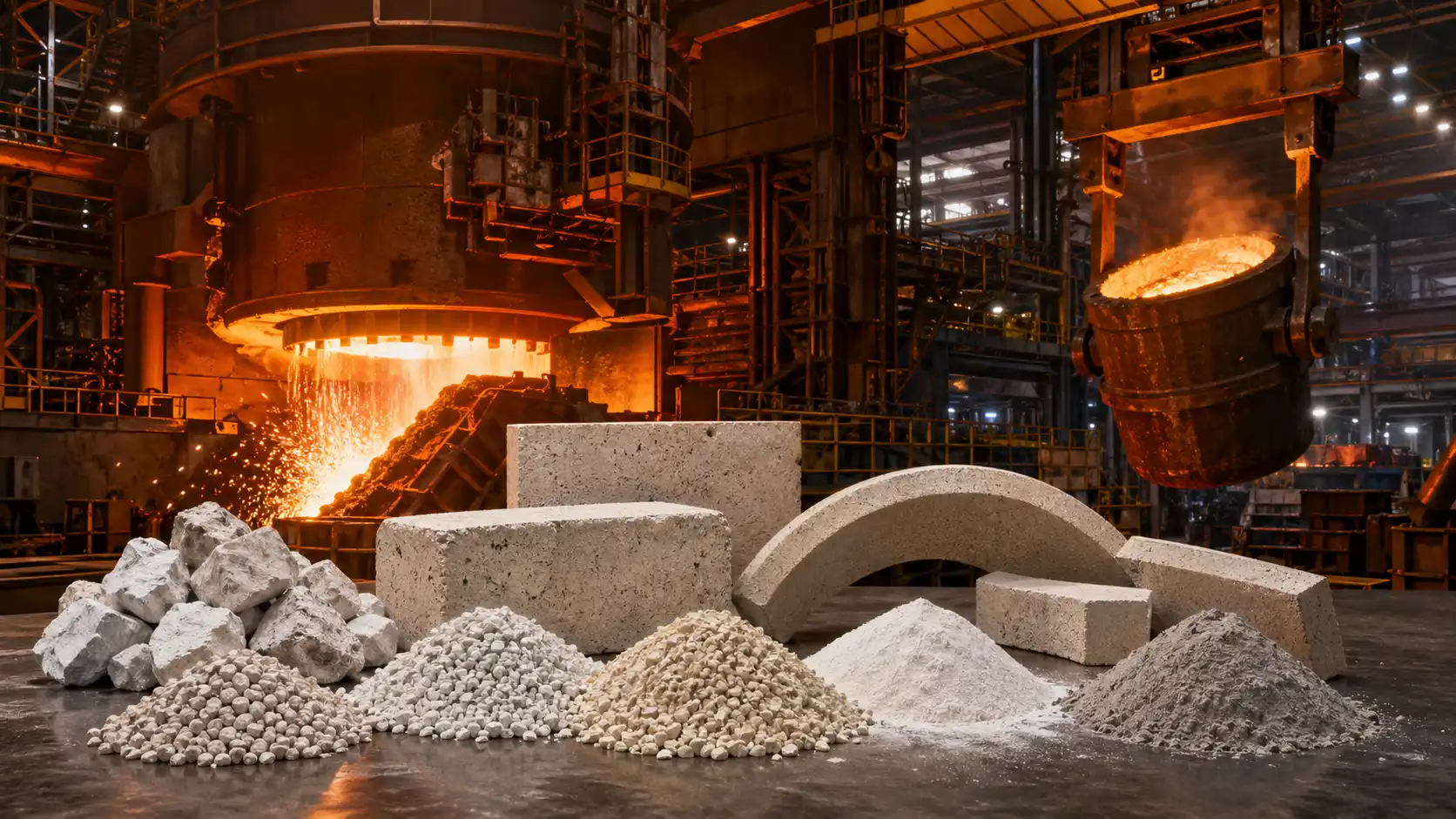
To meet the demanding requirements of steelmaking applications, Kuanxiang relies on Haicheng’s high-grade magnesite resources and its integrated production system covering mining, calcination, and finished product processing to provide magnesia refractory solutions for the steel industry. Our product range includes caustic calcined magnesia powder, dead burned magnesia, medium-grade magnesia, fused magnesia, and magnesia-based gunning materials. Based on different steelmaking scenarios such as electric arc furnace operation, converter processes, ladle linings, and magnesia-carbon brick production, we can match customers with more suitable raw material grades, particle size structures, and quality control standards.
In practical applications, Kuanxiang focuses not only on supplying materials, but also on helping customers improve end-use performance. For customers seeking longer lining life, lower erosion rates, better slag resistance, and improved thermal shock performance, we can recommend more suitable magnesia materials according to actual operating conditions. This helps customers reduce relining frequency while maintaining reliable refractory performance and improving equipment continuity.
As the steel industry moves toward greener and lower-carbon development, Kuanxiang can also provide magnesia products that better support environmental requirements and carbon management goals, helping customers improve smelting efficiency while adapting to the future demands of green steel supply chains.
Key Benefits
- Extends furnace lining service life and reduces shutdown frequency
- Improves erosion resistance, thermal shock resistance, and overall refractory stability
- Supports more efficient and continuous steel production
- Helps meet higher environmental standards under the trend of green steelmaking
Recommended Products
- Fused Magnesia
- Dead Burned Magnesia
- Medium-Grade Magnesia
- Caustic Calcined Magnesia Powder
- Magnesia-Based Gunning Materials